
SEO for AI: What It Is, Why It Matters, and What You Should Know Right Now
If you’ve been keeping half an eye on the world of digital marketing lately, you’ve probably noticed a lot of noise around “AI SEO.” Maybe you’ve come across terms like GEO or AEO and wondered whether they’re genuinely important or just the latest round of marketing buzzwords.
They’re genuinely important. And here’s why.
First, a Quick Recap of Traditional SEO
For years, search engine optimisation has been about one primary goal: getting your website to rank highly on Google. You do that through a mix of great content, the right keywords, quality backlinks, and a technically sound website. Someone types a question into Google, Google serves up a list of links, and, if your SEO is doing its job, your website is near the top of that list.
That model has worked brilliantly for a long time. And it still matters. But something significant has shifted.
The Way People Search Is Changing
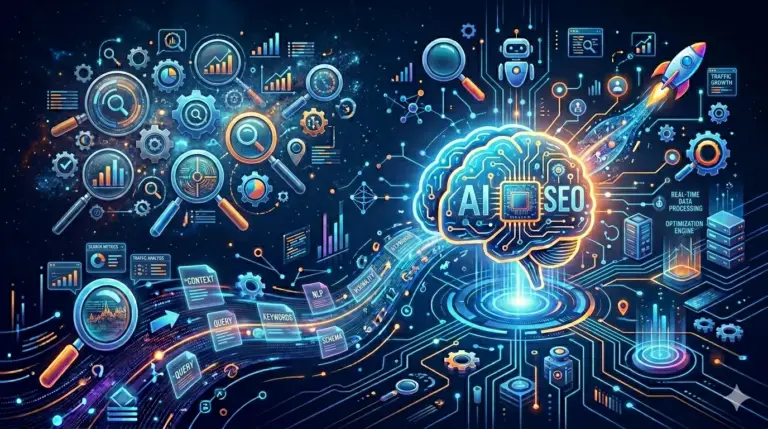
AI SEO is the process of optimising a website to improve its visibility by making its content accessible, understandable, and extractable for artificial intelligence systems. That’s a meaningful distinction from traditional SEO, which is primarily about ranking pages in search engines.
Think about how you might use ChatGPT, Google’s AI Overviews, or Perplexity to find something today. Instead of getting ten blue links, you get a synthesised answer, a confident, conversational response that pulls from multiple sources and gives you what you need without you having to click through anywhere.
Ahrefs found that AI overviews reduced click-through rates for top-ranking Google content by 58%. That’s a dramatic shift. And over 60% of Google searches now end without a click to a third-party website.
So what does that mean for your business? It means that ranking on page one of Google, while still valuable, is no longer the whole picture.
Meet the New Acronyms: AEO and GEO
The industry has developed two terms to describe the new disciplines businesses need to understand:
AEO — Answer Engine Optimisation
Answer Engine Optimisation is the practice of optimising content to appear directly in AI-generated responses and featured snippets. It focuses on providing immediate, authoritative answers to specific user queries. Think of the box that appears at the top of a Google results page that directly answers your question, AEO is about getting your content into those spaces.
GEO — Generative Engine Optimisation
GEO is the practice of structuring content so that AI models can easily cite and include it within synthesised responses. Unlike traditional SEO, which focuses on directing users to a specific webpage, GEO aims to position a brand as a trusted source within AI-generated conversations.
In plain English: when someone asks ChatGPT or Perplexity a question relevant to your business, GEO is about making sure your brand, your expertise, or your content is part of the answer they get back.
So Do You Need All Three — SEO, AEO, and GEO?
Yes, but don’t panic! In practice, SEO, AEO, and GEO work best as a complementary, three-layer strategy: SEO establishes baseline visibility across traditional search engines, AEO ensures accessibility in answer-driven search features, and GEO positions content as trusted reference material for generative outputs. GEO and AEO don’t replace SEO. SEO lays the foundation for better success in AI search visibility.
The good news is that the fundamentals of good SEO; clear writing, genuine expertise, well-structured content, a fast and trustworthy website; are exactly the foundations that AEO and GEO build on. You’re not starting from scratch. You’re evolving.
What Does This Mean in Practice?
Whether you’re a small business owner or part of a large enterprise marketing team, there are a few things worth knowing:
Write for humans first, AI second. AI looks for content that’s easy to parse and reference, with authority indicators showing it can be trusted, that means plain, precise language that’s easy for AI systems to interpret, avoiding ambiguity, complex phrasing, or unnecessary jargon. Helpfully, that’s also just good writing advice.
Structure your content clearly. Use headings, short paragraphs, and direct answers to common questions. AI systems are looking for content they can extract and reference confidently.
Build authority consistently. Entity clarity; ensuring your brand, products, and key topics are represented consistently across all platforms; is essential. This includes maintaining consistent naming across all platforms and using structured data to define your brand’s attributes. For smaller businesses, this might mean making sure your Google Business Profile is complete and your website clearly explains who you are and what you do.
Don’t abandon traditional SEO. Nearly 40% of Google’s AI Overviews rank in the top 10 organic search results. Strong traditional SEO still feeds into AI visibility, it’s a feature, not a bug.
The Bigger Picture
In this new era, visibility isn’t just about being found, it’s about being chosen by AI. That’s a meaningful shift in how we think about online presence, and it applies to businesses of every size.
The brands that will win in search over the next few years are the ones building genuine authority in their space; through helpful content, clear expertise, and a website built to communicate that credibility to both humans and machines.
At ChampagneWebs, we build websites with all of this in mind. Because a great website in 2026 isn’t just designed for the people visiting it; it’s designed to be found, referenced, and trusted in an AI-powered world.
Want to know how your current website stacks up? Get in touch and let’s find out.